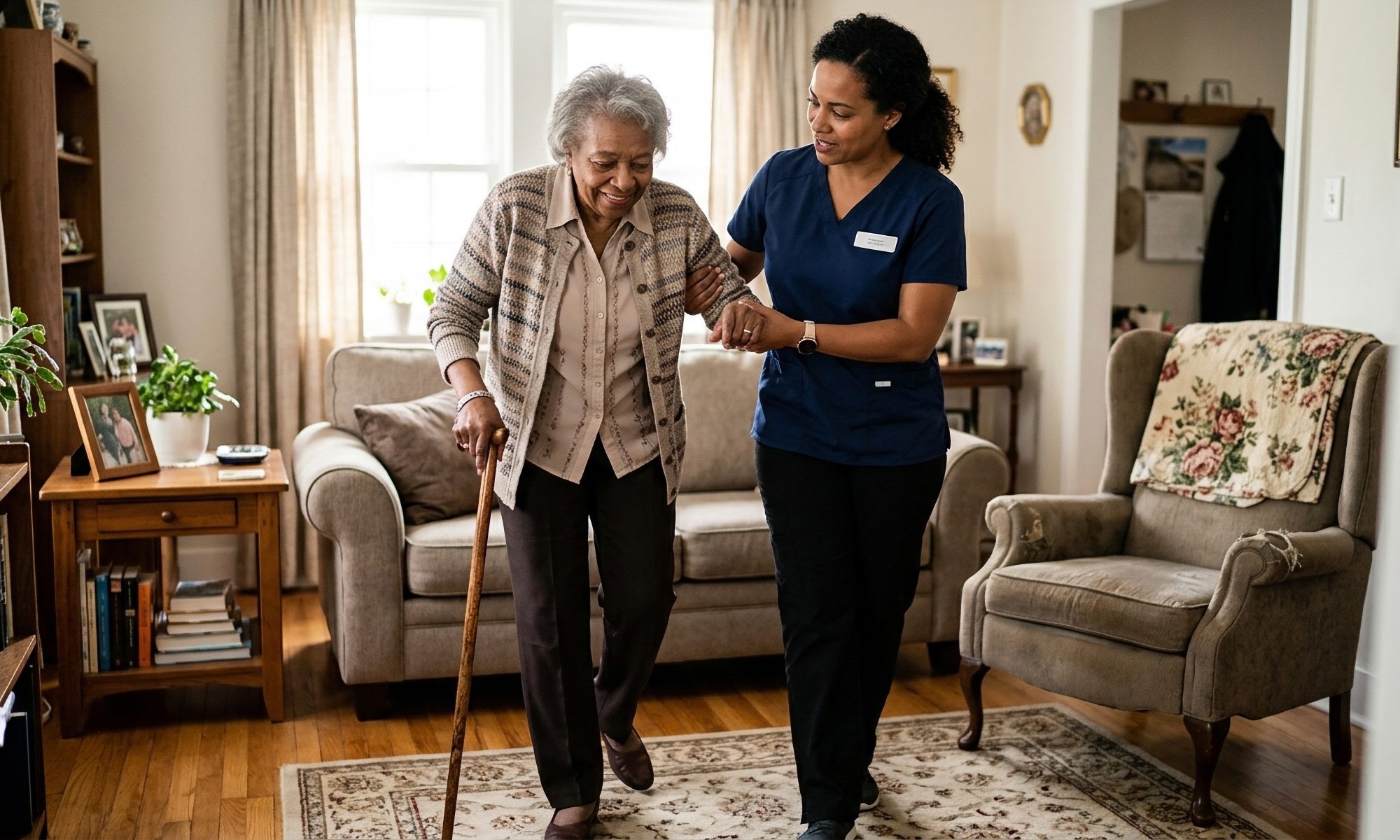
Home care for seniors with vision loss focuses on adapting the living environment through better lighting, contrast, decluttering, and consistent organization so seniors can move safely and confidently. These changes, paired with supportive daily routines, can preserve independence and reduce the risk of falls or accidents at home.
How Can Lighting Improvements Help Seniors with Vision Loss?
Good lighting is one of the simplest and most effective ways to support seniors with low vision. Bright, evenly distributed light reduces shadows and glare, making it easier to identify objects, read labels, and navigate rooms.
- Add task lighting near reading areas, kitchen counters, and bathroom mirrors.
- Use motion-sensor lights in hallways and staircases for nighttime safety.
- Replace dim bulbs with higher-wattage, warm LED lights to reduce eye strain.
- Minimize glare by using curtains or blinds to control natural light.
Vision loss can have a major effect on the ability to perform everyday tasks, but help is just a phone call away. Some seniors only require help with a few daily tasks so they can maintain their independence. However, those living with serious illnesses may need more extensive assistance. Luckily, there is professional 24-hour home care Portland seniors can rely on. Home can be a safer and more comfortable place for your loved one to live with the help of an expertly trained and dedicated around-the-clock caregiver.
Why Does Color Contrast Matter for Seniors with Low Vision?
Color contrast helps seniors distinguish between objects, surfaces, and edges that might otherwise blend together. This is especially important in areas where missteps or spills are common, such as the kitchen and bathroom.
- Use contrasting colors for stair edges, doorframes, and light switches.
- Choose plates and placemats that contrast with the dining table.
- Apply brightly colored tape to mark the edges of steps or thresholds.
- Avoid patterned rugs or floors, which can visually confuse depth perception.
What Household Changes Reduce Fall Risks for Seniors with Vision Loss?
Falls are a leading concern for seniors with impaired vision, but small adjustments can significantly lower that risk. A well-organized, clutter-free home allows seniors to move with more confidence and predictability.
- Keep pathways clear of furniture, cords, and loose rugs.
- Secure rugs with nonslip backing or remove them entirely.
- Store frequently used items within easy consistent reach.
- Install grab bars in bathrooms and handrails on both sides of staircases.
How Can Technology Support Independence for Seniors with Vision Loss?
Assistive technology has advanced significantly, offering seniors more tools to manage daily life independently. These devices can complement environmental changes and provide added peace of mind.
- Voice-activated assistants can set reminders, read messages, or control lighting.
- Large-button phones and remote controls simplify everyday tasks.
- Magnifying tools and talking clocks help with reading and time management.
- Smart labels or color-coded stickers can help seniors identify medications or household items.
There are a variety of age-related health conditions that can make it more challenging for seniors to live independently. However, many of the challenges they face can be easier to manage if their families opt for professional Portland home care service. Families can rely on expertly trained caregivers to keep their loved ones safe and comfortable while aging in place.
What Daily Habits Help Seniors with Vision Loss Stay Organized?
Consistency is key for seniors adapting to vision loss. Establishing predictable routines and organizational systems reduces confusion and builds confidence over time.
- Keep furniture and decor in the same place to maintain spatial memory.
- Label drawers, containers, and cabinets with large print or braille labels.
- Use a consistent system for organizing mail, bills, and important documents.
- Encourage a regular daily routine to reduce reliance on visual cues.
Living independently is important for seniors who want to maintain a high quality of life. For some, this simply means receiving help with tasks that have become more challenging to manage over time. Even when families have the best intentions, they may not have the time to provide the care their elderly loved ones need and deserve. If your loved one needs help to age in place as independently as possible, reach out to Assisting Hands Home Care, a trusted provider of respite, 24-hour, and overnight home care Portland seniors can depend on. Trust your loved one’s care to the professionals at Assisting Hands Home Care. To create a customized home care plan for your loved one, call us today.
Frequently Asked Questions
What’s the most common cause of vision loss in seniors?
+
Age-related conditions such as macular degeneration, cataracts, and glaucoma are among the most common causes of vision loss in seniors.
How can I make my loved one’s bathroom safer for low vision?
+
Install grab bars, use contrasting colors for fixtures, and add nonslip mats to reduce the risk of slips and falls.
Are there specific colors that are easier for seniors with vision loss to see?
+
Bright, high-contrast colors like yellow, red, and orange are generally easier to distinguish than muted tones or pastels.
Can lighting changes alone make a big difference for seniors with low vision?
+
Yes. Improving lighting is one of the most impactful and affordable changes, significantly enhancing visibility and reducing strain.
How often should a home be reassessed for vision-related safety?
+
It’s a good idea to reassess the home every six to twelve months or whenever a senior’s vision or mobility changes.
